
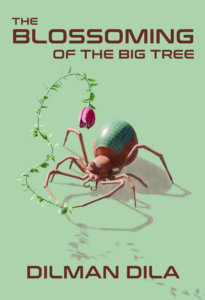
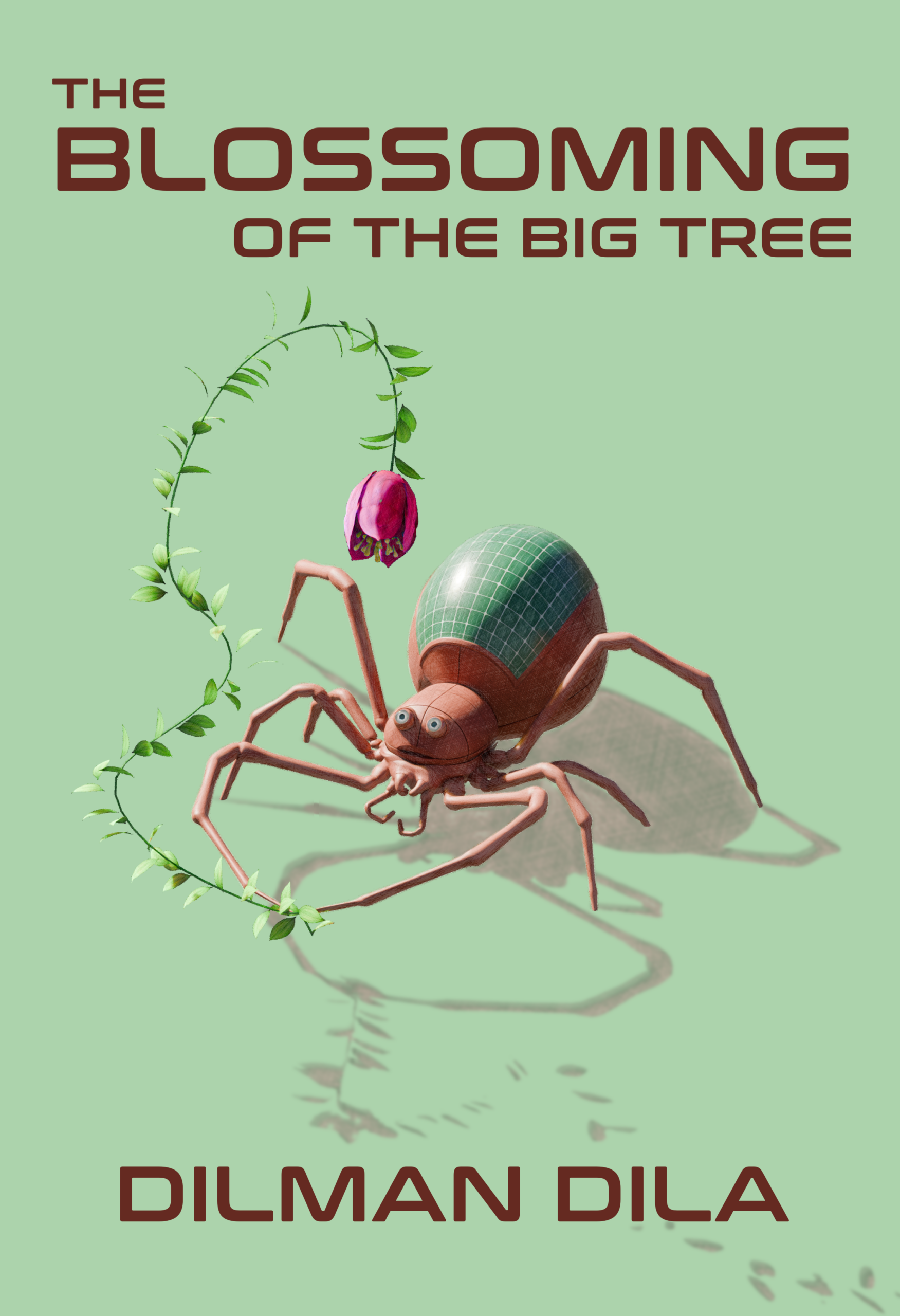
The Blossoming of the Big Tree
Dilman Dila
Novella | 22k words | 73 pages
Genres: Science Fiction | Solarpunk
Release Date: 1 July 2026:
Click Here To Pre-Order

USD eBook: $7 | Audio $10 | Audio+eBook $15
UGX eBook: 20k | Audio 30k | Audio+eBook 45k
Price: USD $7 UGX |15,000
Price: USD $7
UGX 15,000
Price: $7.00
Price: $7.00
.mobi .epub .pdf
Price: $10.00
AudioBook $10
Pre-Order
.mp3
Blurb
A peasant woman has to organize the defense of her decentralized country when a colonizer attacks.
Description
Coming soon
Reviews
Coming soon
Product Details
Publisher Ododo Press
Publish Date 1st July 2026
Pages About 80 pages
Language English
Type Ebook, AudioBook, Print
ISBN (not yet available)
Categories: Science Fiction, Solarpunk,
About the Author
Dilman Dila is a writer and filmmaker. His books include Where Rivers Go To Die, which was shortlisted for the Philip K Dick Awards (2024), and The Future God of Love. He was shortlisted for the BSFA Awards (2021), the Nommo Awards for Best Novella (2021), and the Commonwealth Short Story Prize (2013), among many accolades. His short fiction appeared in The Best Science Fiction of the Year: Volume Six, and in The Best of World SF V.2, among many anthologies. His films have won multiple awards. For more of his life and works, visit www.dilmandila.com
Chapter 1
When Adita was a child, she loved to lie on her back in the grass, daydreaming as she watched clouds twirl and morph into fanciful shapes, looking pretty against the blue heavens. Now, she glared at them. They looked more like balloons full of sand, stacked together to imprison the sun and prevent her from powering up her tractor. Yesterday, she forgot to charge it. No. Not forgot. Rwot duty kept her too busy. It needed an hour of strong sunlight, but the rain-makers warned that the clouds would wrap her village in gloom all day, perhaps all week. To plough, she had to pedal.
Kolo!
The thought of pedaling made her knees to throb with a false pain, encouraging her to borrow a spare battery. But when she stepped out of the storage-hut, she walked only a few paces before stopping, her mouth twisted in revulsion as she glared at her nearest neighbour, Omita. His homestead was about a hundred meters away, the huts lurked behind the tall grass like monsters waiting to eat her. There were about ten huts in that courtyard, some two stories high, others three, all with mud-brown walls and green rooftops that gleamed like wet foliage. They dwarfed her huts, which were closer to the peasant shelters she had grown up in, for she lived with only five grand children and so they did not need gigantic houses. Palm trees stood stiff around her home, like sculptures of evil spirits waiting to pounce on her the moment she stepped out of her compound. She sighed. Omita, an amiable father of nine, would insist on sharing a cup of porridge and gossip before lending her the battery. Lakwena, the neighbour to her left with over fifty people in her courtyard, and about twenty huts, would invite her to snack on roasted groundnuts and then narrate the entire plot of whatever silly TV drama she drowned in every evening. The other neighbour, Ogwapus, too far for her to see his homestead, would insist on bringing his tractor to plough her garden himself, then settle for a calabash of beer and loiter in her compound until evening. Kolo! Her bones might be seventy years old, but they could still pedal. Instead of thirty minutes with a battery, it would take three hours to clear the garden, perhaps five since she lacked the strength of youth. But it would be a good excuse to stay away from her vidisimu. Oh, I was in the garden and didn’t hear it ring, was it anything urgent? No, of course no call is ever that urgent.
A temptation nearly overcame her to plug the tractor into a wall-outlet. Don’t! They would drain the pokpot solar panels, which were made from a paste of leaves and algea, and they used photosynthesis to generate electricity. In weak daylight, they had very low capacity. In the night, they released the energy they had stored to power her homestead. If the clouds hid the sun for three months, they would use up all their energy and die. Then, she would endure the month-long process of manufacturing new panels, and, in that time, how would she cook?
Kolo!
She trudged back into the storage hut and straddled the tractor, which had the frame of a bicycle, but with six long and spindly legs instead of wheels, and with a box-shaped trailer, which housed an engine and had solar stone-slats on top and a plough at the bottom. She flipped a switch from Power to Pedal, gripped the handlebars, pulled a lever, and the legs stretched, lifting her ten feet above the ground. She eased it out of the hut and walked it to her garden, only twenty meters behind her homestead, but it knocked the wind out of her. Kolo! Just go to the neighbours! They had larger families and bigger gardens, and a lot of spare batteries since they had the labour to manufacture them, but they also had very loose mouths and very nosy noses. She gritted her teeth, engaged the plough gear, and now when she pedalled, her legs were heavier than iron bars.
The garden, on about an acre of land, had two stories. The upper floor was twenty feet high, with rows of pots hanging on poles. She had planted beans in them, and she wanted to plant potatoes on the ground-level, but it was overgrown. Kolo! Pedalling is good exercise! When she was a child her grandfather dug his garden with bare hands and a hoe, though he was about the age she was now, but her generation had become lazy because of machines.
She huffed and puffed and twenty minutes later she had ploughed only ten meters. Sweat filled her wrinkles and her knees screamed. She again looked over the grass to her neighbours, gritting her teeth, but could not find courage. She needed to recover from yesterday’s meeting, which had lasted fifteen hours. She had talked, and talked, and then eaten with other people and even shared a calabash of millet brew with them, though their odours suffocated her. It was an argument over a wedding, and she had imagined it would require only a few hours to resolve, but the groom’s side refused to contribute to the feast, and the bride’s people threatened to stop their daughter from marrying into a stingy family. The bride insisted on marrying in a six days, and so Adita, being rwot, had to find a solution. By the time she returned home long after sunset, her mouth was full of sand and salt, crickets shrieked in her ears, and fingers of other people crawled on her skin like maggots, all night! She needed today to herself.
Why did I accept to be rwot?
The disc blades of the plough sunk into the ground. She huffed and puffed and pedaled, cursing her age, her joints creaked. Sweat drenched her clothes, as if she had fallen into a river. Her life would have been easier if she allowed adults to live in her homestead. They would have helped with this kind of work. Kolo! Why am I like this? She stopped, and again glanced at the huts in the distance, the solar pastes on their roofs gleaming like beacons, and it was a mystery to her why she could not just walk over to borrow a battery.
Something in the periphery of her vision distracted her. She turned to see a bruka, painted in the colours of a leopard, flapping its wings as it raced to her home.
Kolo! She cursed under her breath. Let me work my garden in peace!
The pilot was Ogen, a lawang rwot, technically her deputy but so full of indecision that she wondered why the village nominated him for the job. Oh, she could not understand why they picked her either! Perhaps the person who suggested her name wanted to punish her with the most tedious role. Until recently, people campaigned for leadership positions, but this threatened to nurture the kind of corrupt system that Yat Madit had replaced. Though rwot enjoyed no material benefits, and had no political influence beyond the village, some people rewarded themselves once they became rwot, either by robbing the collective stores or making people work for them, so someone proposed a law forbidding campaigns. Instead, citizens nominated candidates and the village reached a consensus on who should lead. Strict laws were passed forbidding rwot or their family from accessing the collective store, or asking anyone to do any kind of work for them. When it became clear that the village thought she should be rwot, she hesitated to accept, but the job would give her an excuse to meet people regularly without engaging in small-talk, or gossip, or discussing melodramatic series over calabashes of beer. And no one would ask her that disturbing question; Why are you always alone? No one would think of banishing her because she did not enjoy the company of other people.
The ornithopter hovered above her homestead for a few moments and perhaps the children playing in the courtyard pointed out that she was in the garden for it turned toward her, and landed a few feet away. It was a small craft, just a little larger than the motorcycle her father had ridden. Some called it a flying bike, for like the tractor it used the frame of a bicycle, though it had an oval shaped body with bird-like wings on top. Ogen flipped open it’s single door, but did not get out.
“Thank you,” he said in greeting.
“I’m busy,” she said. “Whatever it is, handle it.”
“You didn’t wake up very well,” he said.
“When do I get to work my garden if I spend all my time on rwot duty?”
“Isn’t there someone to help you?”
No! The retort could not escape from her throat, and she thought about proposing a law to ease the burdens of leadership. They could not expect rwot to spend all their time chairing meetings and leave their gardens unattended. But if she lived in a large family like everyone did, she would not have to work the garden. The young people would do the hard and dirty work while old people like her sipped beer all day. After her husband had died, about ten years ago, she had subtly sent away other adults from her homestead, leaving her with only pre-teen children, and so she had to pay the price.
“You are my deputy,” she said. “Handle whatever it is.”
“There’s a gengo person in our village,” he said.
That knocked out the little breath she had left. She bit her lips to stifle the growing anger, and she tried to keep her voice friendly. She even smiled. As rwot, she merely chaired the committee that governed the village, but in delicate issues, like gengo, she had to participate in whatever decision the committee came up with. It was just bad luck that for two days in a row things came up demanding her presence, forcing her to endure the company of others. Still, she tried to avoid it.
“The rules are clear,” she said. “If he’s blocked he can’t stay. Throw him out.”
“He’s been here for three days already,” he said.
“Three days!” The words burst out of her mouth like fire out of a flame thrower.
“His mother tried to hide him.…” he trailed off.
If word got out that Rac Koko, her village, hosted a person on gengo, the federation might block them as well. Then, in crisis, like when the clouds hid the sun for so long that all their batteries ran out, villages in sunny places would not help them to recharge. They were largely self-sufficient with enough food in their granaries to last about five years, but a gengo would deny them essentials they could not produce, like salt, or delicacies they had to import, like avocado, fenne, and gonja. And citizens of Rac Koko would be barred from attending festivities that brought together people from many corners of the federation. They would be blocked from downloading new melodramas, and music, and enjoying the social media feeds from other villages.
“What did he do?” she asked.
“He beat his wife,” he said.
Oi, she cried. The most heinous reason to gengo! Hosting such a person might get her village blocked for two years as punishment.
“Stay here,” she said. “Help clear my garden.” It was okay for her to ask another leader to help her with work.
“How will you fly to the centre?” he said.
End of excerpt. This book will be available on 1st July 2026.
Nothing here yet
Not yet available.
not yet available
Similar Books

eBook $7
Pre-Order
.mobi .epub .pdf
Price: $7.00